
By Lee Anne Tourigny
One of the unique features of the photovoice method is that, unlike traditional qualitative research, it generates opportunities for underrepresented populations, or people who historically have not had a voice, to have a say in the decisions that affect their lives. Though commonly practiced within the health and public health sectors, it currently extends to a variety of populations and contexts. Examples include ethnic minorities, migrants, veterans, incarcerated persons, and people experiencing homelessness. (Belli, 2024; Clary et al., 2024; Gonzalez et al., 2022; Hines et al., 2022; Humblet, 2025).
Groups implementing photovoice projects include researchers and professors in academia, community leaders, schools, municipalities, nonprofits, and grassroot organizations. While following photovoice’s core principles, each individual group adapts the method in such a way that it meets populations where they are. The beauty of photovoice is that facilitators and organizers can adapt every step of the process to best accommodate the culture and needs of the participants.
Photovoice in Healthcare and Disability Settings
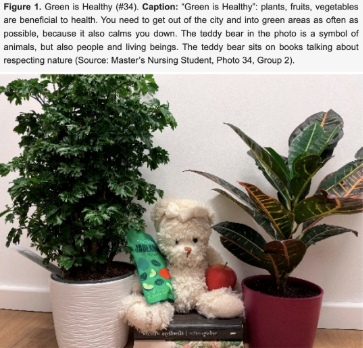
Over the decades, photovoice has been used to understand the lived experiences of people with health issues from cancer to HIV, to maternal and women’s health, to substance use (Covil-Manset, 2025; Hurt, 2024; Taboada, 2012). Projects have given doctors, patients, families, and community members valuable perspectives on treatments, the process of the diagnosis, and their journey following treatment. Some projects have looked beyond the individuals with the diagnosis, seeking the perspective of family members as they process their loved one’s journey through diagnosis, treatment, and recovery (Morales, 2012). In one study, researchers looked at a different angle in health, using photovoice to understand the perspective of nursing students as they begin their journey into the health care field (Lickiewicz et al., 2024).
Photovoice has also been used to support individuals with disabilities and their families. Disabilities can range from amputees and wheelchair users to those with mental health disorders and intellectual and development disabilities (Abdulkareem, 2023; Adames-Torres, 2024; Cimino et al., 2025; Singh et al., 2020; Taylor et al., 2020). The method is ideal for accommodating those who struggle with communication, giving them a visual platform on which to share their story and bring to light the physical and social barriers they encounter.
One project with college students and faculty and staff at a university aimed to explore how their disability affects other areas of their life. Through this project, eight individuals gained confidence in their diagnosis and shared their experiences with like-minded people, before informing their university through various dissemination opportunities (The Disability and Identity Photovoice Project, 2024).
Photovoice with Youth
One population often overlooked in research is youth. Commonly implemented in schools and after-school programs, projects include elementary aged, middle school, high school, and early adults (Beckwith et al., 2021; Gonzalez et al., 2023; Solis, 2022). Although topics vary depending on the goals of the project, examples include climate change, their community and neighborhood, the importance of healthy lifestyle habits, and mental health.
A Proven Research Method
Regardless of context, photovoice is a proven research method for participants and their communities and results in valuable data and information. By virtue of its participatory nature, photovoice is unlimited in its applications, allowing any population or community to take control of the narrative and offer fresh perspectives to matters that impact their lives.
Learn more about what photovoice is, how it works, its history, and why it matters. https://www.photovoiceworldwide.com/what-is-photovoice/
About the Author: Lee Anne Tourigny was an intern and then a team member at PhotovoiceWorldwide from 2021 through 2026. Notably, she established and was managing editor of PVWW’s LinkedIn newsletter from 2024-2026.
References
Abdulkareem, O. (2023). A picture of [perfect] mental health: Using photovoice to examine the challenges and opportunities for success among first-generation college students [Blog]. PhotovoiceWorldwide. https://www.photovoiceworldwide.com/a-picture-of-perfect-mental-health-using-photovoice-to-examine-the-challenges-and-opportunities-for-success-among-first-generation-college-students/
Adames-Torres, J. (2024). Fostering hope and resilience through photovoice [Blog]. PhotovoiceWorldwide. https://www.photovoiceworldwide.com/fostering-hope-and-resilience-through-photovoice/
Beckwith, S., Lantos, H., & Moore, K. A. (2021, November). Photovoice elicited young adults’ perspectives on positive youth development approaches in workforce training: Lessons from the generation work initiative. Child Trends. https://cms.childtrends.org/wp-content/uploads/2021/11/PhotovoiceThemes_ChildTrends_Nov2021.pdf
Belli, E. (2024). Picturing your story: Migrant children’s experience of the Balkan Route [Blog]. PhotovoiceWorldwide. https://www.photovoiceworldwide.com/picturing-your-story-migrant-childrens-experience-of-the-balkan-route-2/
Cimino, S. R., Nugent, K., Payne, M. W., Viana, R., Hitzig, S. L., MacKay, C., Mayo, A., Dilkas, S., Miller, W. C., & Hunter, S. W. (2025). Understanding barriers and facilitators to accessibility in the built and natural environment for people with lower limb loss: A qualitative study. Prosthetics & Orthotics International. https://doi.org/10.1097/pxr.0000000000000471
Clary, K., Selber, K., Ortiz, R., & West, B. (2024). A snapshot in time capturing student veterans’ well-being: A photovoice study. Journal of Veterans Studies, 10(1), 240–261. https://doi.org/10.21061/jvs.v10i1.539
Covil-Manset, J. (2025). Photovoice amplifies substance use recovery. Duke University School of Nursing. https://nursing.duke.edu/news/photovoice-amplifies-substance-use-recovery
Gonzalez, M., Kokan, Z., Azevedo, B., & Damian, A. J. (2022). Through their eyes: Examining youth homelessness with photovoice. [Policy brief]. Weitzman Institute. https://www.weitzmaninstitute.org/wp-content/uploads/2022/02/PhotoVoice-Policy-Brief_Final-002.pdf
Gonzalez, N., Belobrovkina, E., & Rodgers, S. (2023, December 7). Photovoice as an educational supplement in middle school and high school curriculum [Poster presentation]. Fall Research Day, University of Missouri. https://gregoryscholars.missouri.edu/wp-content/uploads/2024/01/Gonzalez_Poster.pdf
Hines, A. L., Brody, R., Zhou, Z., Collins, S. V., Omenyi, C., Miller, E. R., Cooper, L. A., & Crews, D. C. (2022). Contributions of structural racism to the food environment: A photovoice study of black residents with hypertension in Baltimore, MD. Circulation: Cardiovascular Quality and Outcomes, 15(11). https://doi.org/10.1161/circoutcomes.122.009301
Humblet, D. (2025). Ageing behind bars: A photovoice study in a geromedical prison unit. The Gerontologist, 65(9). https://doi.org/10.1093/geront/gnaf165
Hurt, K. (2024). Healthful eating in the postpartum period: Overcoming nutritional challenges for Black mothers [Blog]. PhotovoiceWorldwide. https://www.photovoiceworldwide.com/healthful-eating-in-the-postpartum-period-a-study-on-nutritional-challenges-facing-black-mothers/
Lickiewicz, J., Kolb, B., Piątek, J., & Lorenz, L. S. (2024). Photovoice and health perception in a group of early-career nurses. Nursing Reports, 14(3), 2192–2206. https://doi.org/10.3390/nursrep14030163
Morales, G. (2012). Photovoice with pediatric cancer parents: Understanding difficulties and communicative behaviors for coping effectively [Master’s thesis, The University of Texas at El Paso]. ScholarWorks@UTEP. https://scholarworks.utep.edu/open_etd/2146/
Singh, H., Scovil, C. Y., Bostick, G., Kaiser, A., Craven, B. C., Jaglal, S. B., & Musselman, K. E. (2020). Perspectives of wheelchair users with spinal cord injury on fall circumstances and fall prevention: A mixed methods approach using photovoice. PLOS ONE, 15(8). https://doi.org/10.1371/journal.pone.0238116
Solis, G. M. (2022). Photovoice: Inclusion through the lens of the child [Master’s thesis, California State University, Sacramento]. California State University, Sacramento. https://hdl.handle.net/20.500.12741/rep:2996
Taboada, A. (2012). Photovoice: Using photography to reduce HIV stigma and discrimination in Guatemala. IntraHealth International. https://www.intrahealth.org/vital/photovoice-using-photography-reduce-hiv-stigma-and-discrimination-guatemala
Taylor, M. L., Prohn, S. M., Chapman, R., Dailey, A., Sellers, T., & Ogston-Nobile, P. L. (2025). Photovoice as a career exploration tool for youth with IDD. Inclusion, 14(1), 58–74. https://doi.org/10.1080/23266988.2025.2583709
The Disability and Identity Photovoice Project. (2024). Home. Google Sites. https://sites.google.com/view/disabilityandidentitypvproject/home
Wang, C., & Burris, M. A. (1994). Empowerment through photo novella: Portraits of participation. Health Education Quarterly, 21(2), 171–186. https://doi.org/10.1177/109019819402100204
Weggler, D. (2024). Empowering youth in uncertain times: Using photovoice to help youth navigate tough choices [Blog]. PhotovoiceWorldwide. Retrieved April 20, 2026, from https://www.photovoiceworldwide.com/empowering-youth-in-uncertain-times-using-photovoice-to-help-youth-navigate-tough-choices/