
By Stephanie Lloyd
In part 2 of this “Back to School” blog series we explore how photovoice can be a powerful tool to use in the classroom with older students as well. Remember: the photograph is only part of photovoice. The ‘voice’ comes from students choosing what matters, explaining the meaning behind their images, listening to others’ perspectives, identifying patterns, and considering what the group has learned or might do next. Since photovoice is a highly adaptable method, teachers can feel free to pull pieces of it into their teaching, or it could be used in combination with other classroom assignments.
If you missed part 1 and are curious about photovoice with elementary students, head over HERE.
Middle School. This is a great age to move from “this is what I see” to personal experiences of “why is it this way?” Photovoice could also be used to strengthen cross-disciplinary projects and build their data skills. Consider bringing in a guest speaker related to the topic or a photographer to teach skills. Students could also conduct a simple survey and then use their photos/captions to add context to the quantitative data.
For example…
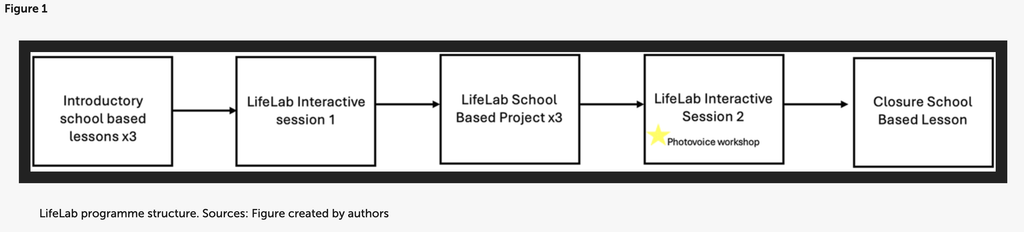
In Burke et al. (2026), 13–14-year-old students used Photovoice as part of a school-based health education program. Students were asked to take at least 10 photographs in their school or community that represented “health” to them. Then, they chose three to bring forward and used an age-adapted SHOWeD questions to reflect on them. Finally, they used their images and worksheets to reflect on what they noticed and discuss health-related strengths, challenges, and possible solutions. Students later participated in a Photovoice workshop where their images became prompts for discussion and action.
–> IDEA:
- Give students photo-taking prompts such as, “What tells you something about this space?” or “What makes you curious about this space?” If you (as the teacher and project facilitator) want to focus on writing, then make sure you provide lined paper and a required number of sentences for each caption.
- Have students submit their photos and captions and post them on the wall ahead of the class time. During a class session, hand everyone a set of sticky notes and have the students participate in a “gallery walk” where they visit each photo/caption and post observations or questions.
Move from inquiry toward research, advocacy, and action. Older students can take significantly more ownership over the entire photovoice process, including deciding on the photo-taking questions or topics, establishing group norms, leading icebreakers at the beginning of each session, organizing images and captions, taking notes during discussions and helping identify themes, inviting guests, and recommending action.
Photovoice Ethics. Before photo-taking begins, facilitators should establish clear project roles and expectations, review relevant school or district photography and media policies, and talk explicitly with students about consent, privacy, respectful representation, and how Photovoice images differ from photos shared on social media. Emphasize that permission to take a photograph is not automatically permission to share or publicly display it. Students should never be required to photograph people, private spaces, unsafe situations, or anything that makes them uncomfortable; objects, places, staged images, drawings, or existing images can offer meaningful alternatives.
For example…
Photovoice does not have to be a stand-alone activity and it can be paired with participatory mapping, observation, discussion, and problem-solving. It also gives a very concrete way to move from “What do students notice?” to “What could we change?”
In a Photovoice project at a public high school in Cape Town, South Africa, students explored what made them feel safe or unsafe at school (Zuch et al., 2013). After learning about photography, visual storytelling, and photo ethics, students completed a risk-mapping activity (similar to hot spot mapping) by placing stickers on a school map to identify safe and unsafe places. Then, they photographed spaces and situations around the school that illustrated their concerns. Back in the group, students selected photographs, wrote captions, discussed the stories behind the images, and brainstormed possible solutions. Their photographs and risk map were ultimately displayed at a forum where students presented their findings and recommendations to the principal, teachers, parents, police officers, education representatives, and other community members.
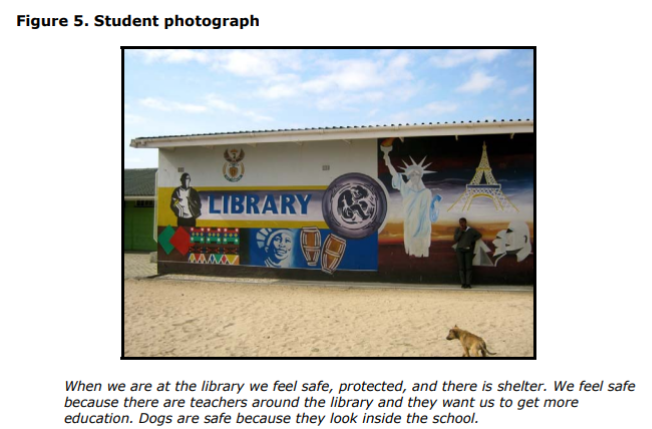
NOTE: A safety map should never become a list of places students are expected to enter or photograph. Students can photograph a symbol or nearby environmental feature, stage an image, draw the location, or simply discuss what appears on the map.
–> IDEA: Have the students create a project and then culminate in a presentation during a student assembly, a podcast, school-board presentation, or posters hung up around school. Potential project topics include:
- Community Assets and Gaps: Students photograph both things their community does well and areas where they see opportunities for improvement, answering the questions “What is working well here, and what could be better?”.
- Climate Change Close to Home: In Science class, students document their relationship with nature and how environmental conditions appear in their own communities.
- Visual Sociology: In Social Studies, students explore concepts such as social class, community, identity, institutions, norms, inequality, or social change through photographs and written analysis.
- Visual Rhetoric: In English class, students analyze how images communicate arguments and then create their own photograph-and-caption series around an issue they care about.
- Career and Technical Education: Ask students to document how design, accessibility, safety, communication, or human behavior show up in real environments connected to their field.
- Health and Well-Being: In Health class, students photograph things in their school or community that support or create barriers to their own physical, mental, and social well-being. They might use their photographs to respond to questions such as “What helps you stay healthy and feel well?” and “What could make it easier for you to make healthy choices?”
No Time for a Full Photovoice Project? Try a Photovoice-Inspired Activity
Photovoice does not have to mean a multi-week/semester-long project. Teachers can borrow individual pieces of the method to create meaningful one-day or short-term activities at any grade level. Even a short activity can introduce students to an important part of photovoice: slowing down and noticing, using a photograph to tell a story, or deciding what is important in the eyes of students. Photovoice-inspired activities can also be a great way for a teacher to pilot the method before deciding whether to build a larger project into the curriculum. Both teachers and students will benefit from starting the process slowly!
–> IDEA: Here are a few ways to try it:
- Photo Introductions: Lay out a set of photos (e.g., stock images or ones from magazines) and have students choose one when they enter the classroom. At the beginning of class, ask each student to introduce themselves and tell why they chose that image. With a large class size, break into groups or have students partner up to share their stories.
- Photo Walk + Discussion: Take a short walk around the classroom, school, campus, or neighborhood with one guiding question such as, “What surprised you when you looked more closely?” or “Where do you see science in action?” Return to class and have students discuss what they noticed.
- Image + Caption Reflection: Ask students to bring in a photograph connected to the day’s lesson topic, and complete the sentence starters to caption: “I chose this image because…” “This connects to what we are learning because…” or “This photo makes me wonder…”
- Photo Sorting: Display a collection of photos related to the class subject matter and ask the group to sort them into categories. Ask students: What themes emerge? Which ideas appear most often? What is surprising? What is missing?
- Photo Pre-Post: At the beginning of a topic or unit, ask students to photograph what they think the concept looks like in everyday life. Repeat the activity at the end and compare how their thinking has changed.
Photovoice Research & Project Examples for Middle & High School Teachers
Here are a few articles, projects, and resources that can spark some ideas on how to bring photovoice to your own classroom:
- Adams, S. R., Brooks, K., & Greene, M. C. S. (2014). Using PhotoVoice to empower K–12 teachers and students through authentic literacy engagements. Writing & Pedagogy, 6(3), 649–664. https://digitalcommons.butler.edu/coe_papers/16
- Burke L, Gavigan N, Belton S, Goss H (2026), “Health in our school: a photovoice project”. Health Education, Vol. 126 No. 4 pp. 517–533, doi: https://doi.org/10.1108/HE-09-2025-0179
- Trask, S., D’Souza, E. N., Pi, S., Tu’akoi, S., & Bay, J. L. (2024). “Promoting school-based learning about nutrition and physical activity using Photovoice: A systematic review.” Health Education Journal, 83(2), 123–136. https://journals.sagepub.com/doi/10.1177/00178969231222542
- Zuch, M., Mathews, C., De Koker, P., Mtshizana, Y., & Mason-Jones, A. J. (2013). Evaluation of a Photovoice pilot project for school safety in South Africa. Children, Youth and Environments, 23(1), 180–197. https://www.researchgate.net/publication/259750883_Evaluation_of_a_Photovoice_Pilot_Project_for_School_Safety_in_South_Africa
What’s Next?
- Start small. A Photovoice experience does not need 10 sessions or a public exhibition. One thoughtful question, a few photographs, time to listen to the stories behind them, and an opportunity for students to decide what they learned can be a meaningful place to begin.
- Stay tuned for part 3 of this series which focuses on college and university engagement in photovoice projects.
- For more about using photovoice with youth in an out-of-school time context, head over to our blog: Engaging Youth in Community Research through Photovoice.
- Are you interested in planning a photovoice project or activity with middle or high school students and don’t know where to start? Register for one of our trainings or email: info@pvww.org to set up a tailored training or project support for you and your team members.