
By Stephanie Lloyd, MA and Laura Lorenz, PhD, MEd
Southern California is home to an extraordinary diversity of Asian American and Pacific Islander (AAPI) communities. University of California faculty and research administrators facilitated a photovoice project to document diverse religious practitioners and sites of AAPI faith in California. The participating students’ photos, captions, and conversations shared the joys, curiosity, and tensions among different generations of AAPI religious practices and cultures in their communities. Ten students from four California college campuses were trained in the photovoice method, documented faith-based practices and places of worship in their local communities, and used their photos to tell stories and reflect on the intersections of faith, ethnicity, race, and community belonging.
The project aimed to offer a community-based research opportunity for graduate and undergraduate students at the University of California, Irvine (UCI); University of California, Riverside (UCR); California State University, Long Beach (CSULB), and Southwestern College, San Diego (SWC) in Chula Vista. Students’ photos and captions will contribute to the digital archive at UCI’s Humanities Center.
From 2024 to 2026, PhotovoiceWorldwide supported two university leaders in bringing this project to life:
- SueJeanne Koh, Assistant Director of Graduate Futures and Research Engagement, Humanities Center, University of California, Irvine
- Tamara C. Ho, Associate Professor and current Acting Department Chair for Gender and Sexuality Studies (2026-2027), University of California, Riverside
Planning and implementing student visual research across four campuses was a major coordination task for the project leaders, with support from PVWW. First, PVWW facilitated an online orientation to the photovoice method and the project for faculty from different campuses. Once students were recruited, the project’s initial student training session in the photovoice method and this project was hosted online, due to the students’ busy schedules and distance between participating campuses.
The project’s photovoice process consisted of 1) an online orientation to the photovoice method for the participating students, 2) campus-specific sessions to support photo-taking and sharing, 3) final in-person sessions on the UCI, UCR, and CSULB campuses, where student researchers each shared two photos and the stories behind the images, and 4) a meeting of faculty and PVWW staff to review the photos, captions, and in-person sharing and brainstorm approaches to theming and outreach. The students’ deep sharing in the in-person photo-sharing session fulfilled one of the project’s goals of providing a community-engaged, multicampus research collaboration.
Two side by side photos and a caption shared by one graduate student project member showcased an intergenerational collaboration for a Christmas event, hosted by a Korean/American Christian church community in Los Angeles. (Photographer: Yvonne Cha, PhD Candidate, UC Irvine, English. Source: “Mapping Southern California AAPI Religious Communities,” funded through the University of California, Irvine’s Humanities Center and APARRI.)
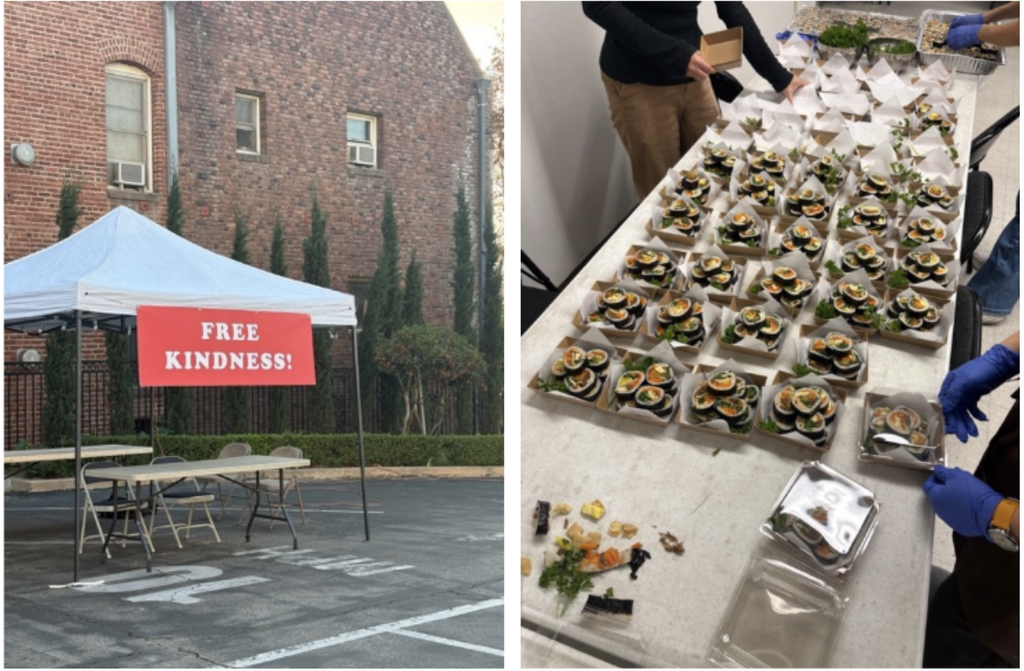
“Just hours before Crossroad Community’s annual “Christmas on Edgemont” — a communal event that invites the Los Angeles neighborhood of Los Feliz to engage with the Korean Christian congregation through recreational activities, food, and musical performances — two prep teams are activated on opposite ends of the church. One sets up a “Free Kindness” booth by the entrance to the parking lot, where church members will provide free hugs and a compassionate ear to locals wandering in. Downstairs, in the basement kitchen, another team rolls huge trays of kimbap, a Korean street food to hand out to attendees. It seems befitting that nothing is more Korean than feeding, nothing more American than therapy, and yet underlying these distinct iterations of “kindness” are particular tensions, entanglements between faith and culture that illuminate the complex dynamics between the first and second generations of the Korean American/diasporic church.”
The example shows how a participant’s photographs and reflections can open a conversation without resolving every tension they describe. Photos taken for the project show places of worship, festival traditions, campuses, and even restaurants. Their captions describe religious and cultural practices that are both familiar and evolving in Southern California’s AAPI communities today.
Photovoice Worldwide’s Stephanie Lloyd and Laura Lorenz provided training, supported the creation of the photovoice project manual, facilitated the photovoice orientation and photo sharing sessions, and brainstormed ideas for theming and exhibiting with faculty leaders. Over the course of the project, the team experienced a few twists and turns, according to PVWW’s Lloyd. “As is typical with many photovoice projects, we had to be adaptable when we hit challenges of recruitment, timing for sessions, and how to pull everything together in a meaningful way.”
“It was extremely helpful to work with Stephanie and Laura to navigate the various questions that arose in our project,” says SueJeanne Koh, ThD. “For example, putting together guides on the ethics of photo taking for our site facilitators and students, and considering what would work best in our context.”
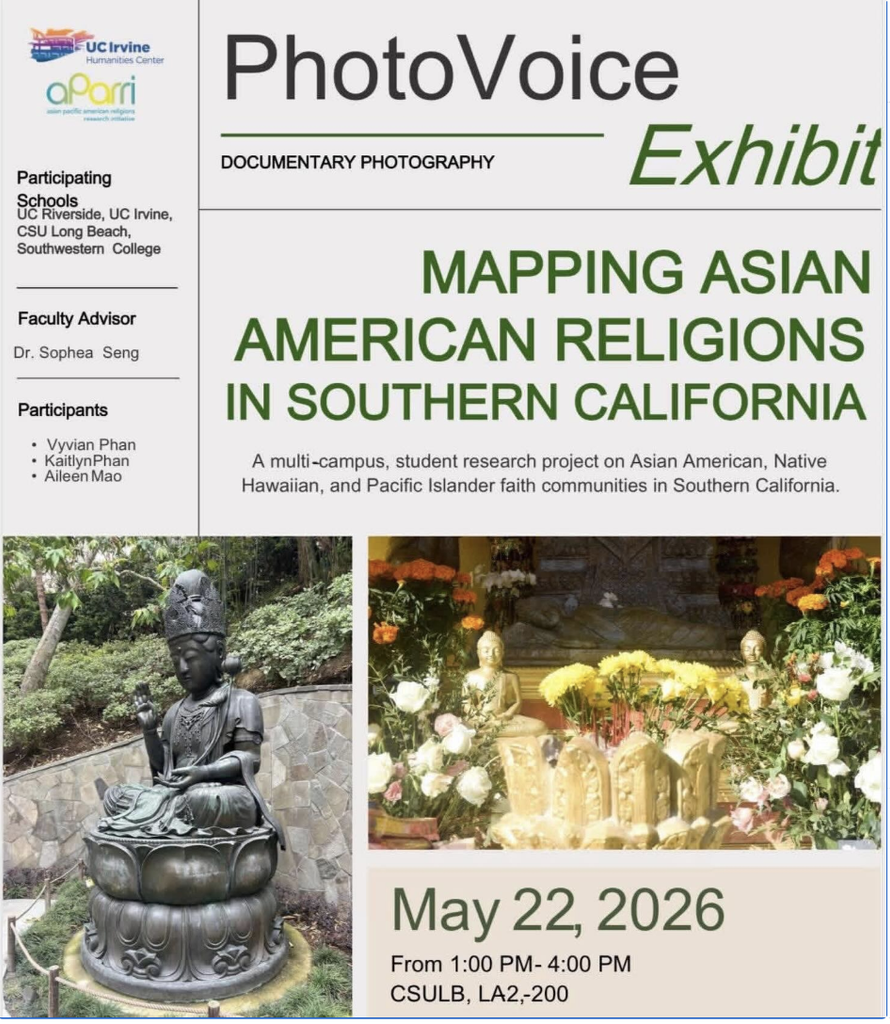
Students’ photos, captions, and conversations document the diversity of AAPI faith communities in southern California and contribute a visual and narrative complexity to the landscape of American religions and their living evolution across generations. After an in-person poster exhibit that traveled across three campuses, the exhibit and additional project photos will become part of the UC Irvine Humanities Center digital archives, available to future generations of students interested in contributing to the understanding of AAPI lived experience with religious practice and faith communities in southern California, and possibly beyond.
The Humanities Center at UC Irvine, funded by the University of California Office of the President Multicampus Research Project Initiative (MRPI), and the Asian Pacific American Religions Research Initiative (APARRI), funded by the Henry Luce Foundation, directed a collaborative photovoice project documenting lived experience with religious practices and faith among Asian American and Pacific Islander (AAPI) communities in Southern California. Participating students explored a wide range of AAPI faiths, spaces, and experiences: Korean/American and Samoan Christian churches; Vietnamese, Korean, and Cambodian Buddhist temples; and centers for Muslim American young adults.
Stephanie Lloyd is Evaluator & Educator and Laura Lorenz is Cofounder & Educator at Photovoice Worldwide.