
By Stephanie J. Lloyd and Laura Lorenz
Photovoice is a participatory method where participants (or co-researchers) are given the opportunity to use photos to share their experiences.
The four-step Photovoice Process as outlined by Lorenz & Bush (2022) includes: answering questions with a camera; communicating in a group; observing commonalities; and communicating to power. While these steps are key to the photovoice method, their sequence may vary, additional activities may be included, and some steps may be revisited multiple times.
Step 1: Answering Questions with a Camera
After participants learn about the photovoice and safety, they are asked to take photos to answer the project questions. Thus, the camera serves as a tool for reflection to document strengths, challenges, relationships, and environments—from the photographers’ perspectives.
“… the process often brings together an unfamiliar ‘outside’ person and an individual or group of ‘inside’ people who use cameras (still and video) to jointly explore a topic of shared concern” (Luttrell & Chalfen, 2010, p.197).
Here is an example of a photo and caption shared during a photovoice session:
The Pandemic Made Us Not Friends

The pandemic has made me mad because it’s taken away from our kids. At my age we were playing Oregon Trail on the computers and snake games. But now the kids have to rely on the computer to get their education, and its hard for kids if they have learning disabilities. No one wants to help or they only want to provide help if it’s convenient for them. My daughter needs assistance logging onto the computer and someone to read to her, and I work during the day. I’ve had several meetings with the school trying to get hard copies of the work, and finally I got them to agree to print the assignments. It’s a stressful scene. The pandemic, internet and e-learning has made me unhappy. Source: Latoya, Co-researcher, Photovoices of Recovery, NAMI-Indianapolis, 2021.
Step 2: Communicating in the Group
Next, participants/co-researchers gather to discuss their photos and write captions using either unstructured or structured dialogue methods, such as SHOWeD (Wang & Burris, 1997) or PHOTO (Hergenrather et al., 2009) questions that can guide the reflection and writing process. Photovoice dialogue strengthens both critical and creative thinking (Lorenz & Bush, 2022). Narratives (or captions) paired with the photos help to contextualize the images, especially when sharing outside the group.
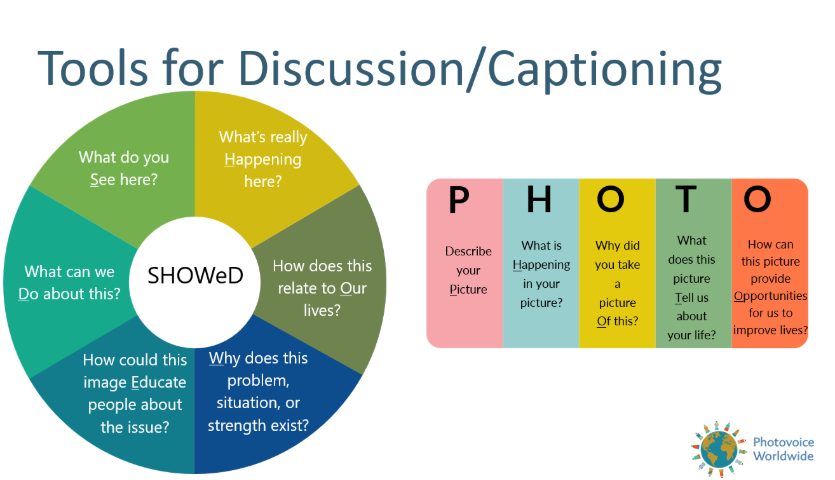
Source: Graphics created by PhotovoiceWorldwide based on recommended questions and acronyms in Wang & Burris, 1997; Hergenrather et al., 2009.
Step 3: Observing Commonalities
Following group photo discussions, it’s important for co-researchers to theme or categorize their photos and captions. This valuable cognitive step allows the group to work together to organize their photos and stories into shared themes that can be easily understood outside of the group. Photovoice theming also fosters teamwork, communication, and confidence, which are skills that extend far beyond the project itself.
To support photovoice theming, facilitators may ask:
- What topics or issues show up repeatedly in our photos or stories?
- What ideas are most important to highlight?
- Where are there differences among our photos?
Step 4: Communicating to Power
As Caroline Wang originally intended, photovoice projects culminate in external sharing through exhibits, community forums, reports, presentations, policy briefings, virtual galleries, etc. Outreach efforts aim to inform decision-makers, shift narratives, and inspire action (Wang & Burris, 1997). Photovoice outcomes can occur across multiple levels of the Socio-Ecological Model: individual, group, community, and society (Strack et al., 2010). When planning a project, it can be helpful for groups to frame their goals with their intended audience in mind, which can also guide how participants develop captions and identify themes.
One project, conducted with UNC Charlotte and Disability:IN North Carolina, aimed to increase personal and campus-wide conversations about how students, faculty, and staff experience their disability and other identities. After a summer of sessions, co-researchers disseminated their work at a conference photo exhibit, a library display, and zines (The Disability and Identity Photovoice Project, 2024).
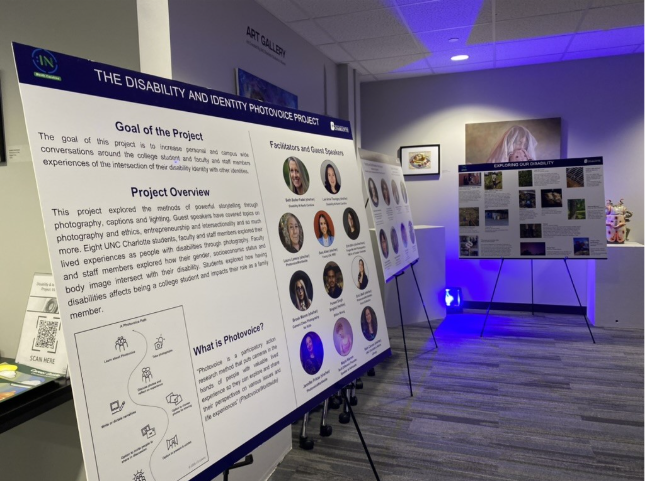
Source: Conference photo exhibit, Disability and Identity Photovoice Project, 2024. Photo take by L.A. Tourigny.
In another project, focused on understanding community members’ financial stories, Community Credit Discovery, a partnership of the University of California Irvine and the nonprofit Abrazar, participants/co-researchers helped to theme and organize their photos, which were later used to develop a toolkit for financial coaches to use photovoice with their clients to help them improve their financial situations (Fan & Wrapp, 2023).
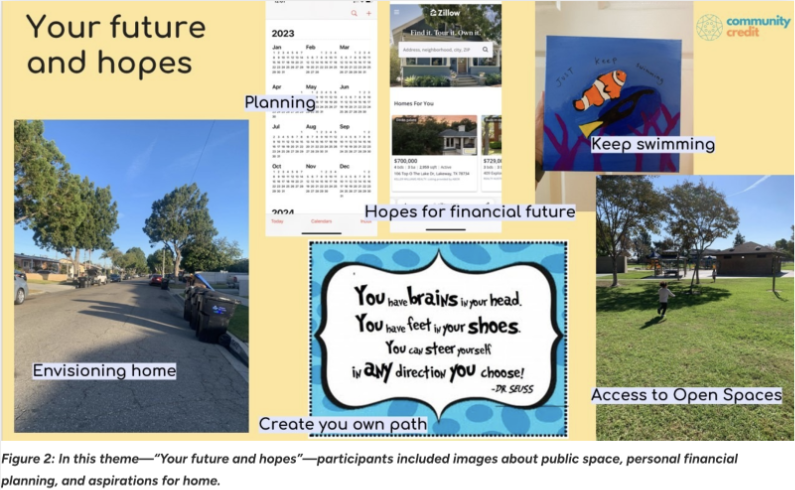
Source: Participant/co-researcher photos and their titles in the theme “Your future and hopes,” Community Credit Discovery, University of California Irvine and Abrazar, 2023.
In sum, the photos and captions generated by photovoice projects can bridge research and community action by centering those most affected by an issue as co-creators of knowledge, empowering them to inform policies and programming and advocate for change.
To learn more about the photovoice method, check out this video: https://www.youtube.com/watch?v=-ok5TQ-P77U (PhotovoiceWorldwide, 2021).
Learn more about what photovoice is, who can do it, its history, and why it matters. https://www.photovoiceworldwide.com/what-is-photovoice/
Stephanie Lloyd is a Senior Consultant and Facilitator at PhotovoiceWorldwide who supports teams confidently plan, facilitate, and evaluate photovoice projects. She has trained individuals around the world to use photovoice as a tool for community engagement, evaluation, and systems change. As an AmeriCorps alum, she believes in the power of participatory storytelling to elevate voices and inspire action.
Laura Lorenz is Cofounder and Educator at PhotovoiceWorldwide. She has been studying the photovoice method, facilitating photovoice projects, and leading photovoice method trainings since 2000. Her popular and peer-reviewed articles, papers, books, and training manuals and toolkits have informed multiple generations of facilitators, researchers, advocates, and clinicians about ways to use the photovoice method in their work.
Stephanie and Laura have been working together since 2018.