
By Lisa Hawke, PhD and Shelby McKee, BA
Our team at the Centre for Addiction and Mental Health (CAMH) used photovoice to explore the impact of co-production in Recovery Colleges for people with mental health and substance use challenges. Recovery Colleges are low-barrier educational settings where people with mental health and substance use challenges can come together and learn from each other. Courses are co-produced and co-facilitated, bringing lived experience into all aspects of programming.
Putting Lived Experience Front and Center
The photovoice project was co-produced by a committee of people with lived experience, Recovery College students, academics, and people with intersecting roles. As team members on equal footing and with equal opportunities for input, we worked together to develop the study plan, the research methods, the project materials, and the knowledge mobilization materials. Lived experience voices were at the forefront every step of the way.
Reflecting all she has learned about photovoice during the process, committee member Kelly Lawless explains “One of the best things about photovoice is that it’s barrier free. It’s a really big thing that everyone is welcome to participate in this space without fear of judgement or stigma.” Project co-lead Sophie Soklaridis adds, “The use of photovoice illuminated experiences that words alone struggle to convey, making those moments both more accessible and deeply felt for participants in the study.”
Knowledge Dissemination
One of the strengths of the project was our multi-faceted approach to knowledge mobilization. We shared the study results with the outside world using a variety of creative channels, far exceeding our usual academic approach. One of the outputs is a webpage hosted on our institutional website, where viewers can see the participants’ photography with the accompanying captions.
https://www.camh.ca/en/science-and-research/research-connect/photovoice-study-of-coproduction
Another knowledge mobilization product we co-created was a YouTube video that walks viewers through the photovoice project and method before highlighting a few of the participants’ photos and accompanying text—some read aloud by the participants themselves. Research Analyst Shelby McKee describes the video: “This video offers a virtual gallery experience that brings participants’ photographs to life, inviting viewers to slow down, reflect, and engage with the stories behind each image in a meaningful and deeply human way.”
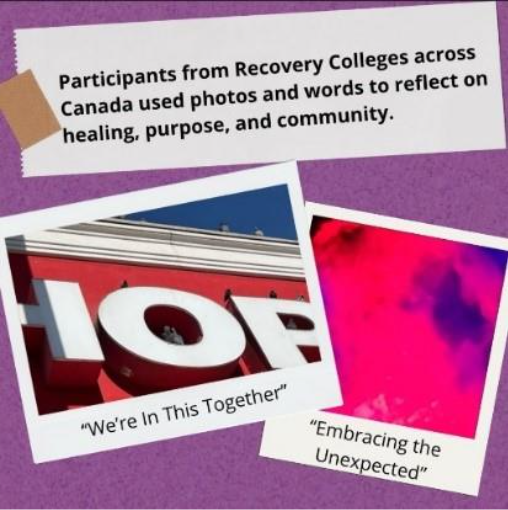
At CAMH, our Public Affairs department showed a keen interest in our project, publishing an online article describing the project to both internal and external visitors.
CAMH also publicized the results through a social media campaign, with graphics and photos.
And, in addition to the publication of this blog post on their website, PhotovoiceWorldwide, Inc. featured the project in the January 2026 edition of its monthly e-newsletter CAMERA>ACTION, which focused on “Photovoice and Recovery.”
Photobooks, Infographics, and a Photo Gala
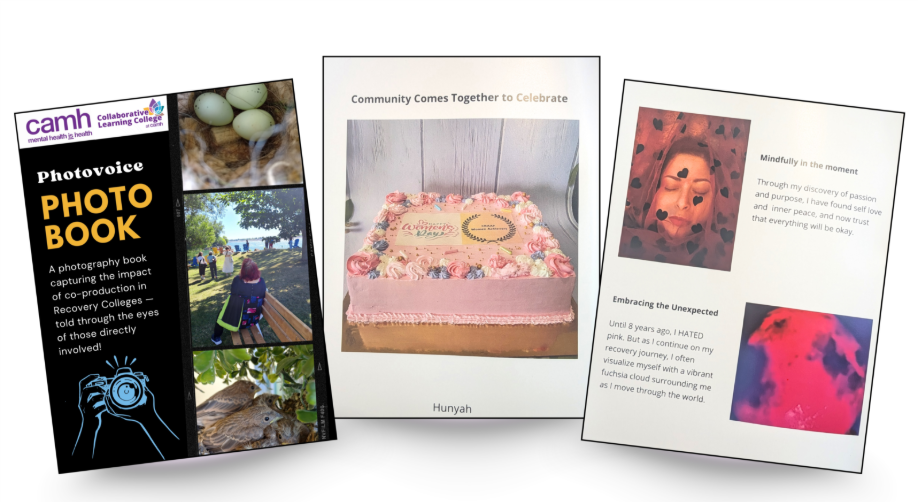
To bring the project alive for the participants and to provide a keepsake for the experience, we created a photobook for them. This full-colour, 24-page booklet features the photography and annotations of the participants across all rounds of the photovoice project. Participants can look back on the photos to remember the experience they had while learning about photography and exploring their experience of co-production.
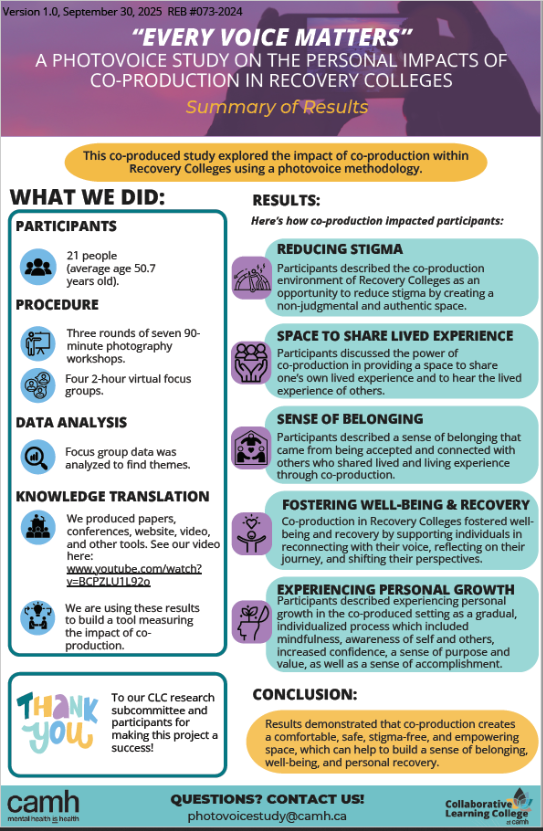
We also created an infographic in which we present the results of the project in the form of written themes and learnings gained from the participants’ expertise. Through this participant-friendly version of the scientific results, we showed participants—in their own words—that co-production reduces stigma, provides a space to share lived experience, and fosters a sense of belonging. At the same time, co-production fosters well-being and personal recovery and gives co-producers the opportunity to experience personal growth. Research analyst Shelby McKee, explains, “We created the infographic with participants in mind—and the response was incredible. Participants said it made the paper easy to grasp, and several reached out again to express how valued they felt throughout their time with us.” She adds, “Some even wrote back to say how much they loved the project and how consistently we put participants first, prioritizing clarity, accessibility, and care.” Lastly, participants had the opportunity to attend a photo gala at the end of the project in which 11 participants presented their photography to 36 attendees.
Academic Papers
Since some of us are academics at heart, we also published the full scientific manuscript describing the project in the journal Health Expectations. This freely available manuscript was co-written by our co-production committee. It describes the project in detail, including the photovoice steps and the approach taken to the research. It also describes the results of the project, with participant quotes about their photos and their thoughts about co-production. A second manuscript that highlights participants’ positive experience of participating in a co-produced photovoice project has been published by the International Journal of Qualitative Methods. We are also presenting the findings at academic conferences, including the Pride in Patient Engagement Research Day and the Annual Conference of the Canadian Psychological Association.
https://onlinelibrary.wiley.com/doi/full/10.1111/hex.70441
https://journals.sagepub.com/doi/10.1177/16094069261426084?int.sj-abstract.similar-articles.10
The project lead, Lisa Hawke, reflects on the knowledge mobilization process. “The creativity of photovoice doesn’t stop with the participants and their photos. It also extends to the knowledge mobilization—or dissemination—phase. So many creative activities are possible. Knowledge mobilization for a photovoice project is a lot of fun and adds to the project as a whole!”
Although embedded in an academic research setting, the team was nonetheless able to expand the project’s reach using a wide range of creative knowledge mobilization activities. Lisa added, “This got the information out there in a way that is dynamic and meaningful for the participants, for the co-production team, and for the institution itself.”
Funding: This project was generously funded by the Tim and Frances Price family.
Authors: The authors are the members of the CLC Research Subcommittee. They are a diverse group of people with lived and learned experience, and the intersections between them.
About the authors
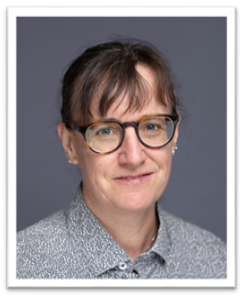
Lisa Hawke is a Staff Scientist at CAMH. Her research platform is evolving to focus on the engagement of people with lived experience in mental health and substance use research. She also conducts research on issues relevant to people with lived experience.
Lisa D. Hawke, Ph.D.
Scientist, Centre for Addiction and Mental Health
CAMH Scientific Lead, Lived Experience and Family Engagement in Research
Associate Professor, University of Toronto, Department of Psychiatry
Associate Editor, Health Expectations
60 White Squirrel Way, 316, Toronto, Ontario M6J 1H4
Shelby McKee is a research analyst with a strong foundation in psychology. She has worked at CAMH for over three years, contributing to projects that advance mental health and substance use care through meaningful engagement with people with lived and living experience.
Shelby McKee, BA
Research Analyst
Centre for Addiction and Mental Health
60 White Squirrel Way, 316, Toronto, Ontario M6J 1H4